

Are Drums Hard to Learn for Kids? What Parents Should Know
Wondering if drums are hard for kids to learn? See what feels easy at first, what takes more practice, and how drum lessons can help beginners progress.
November 2, 2026
Featured
Drums are generally easy for kids to pick up initially, though they become more challenging as coordination and limb independence demands increase. The good news is that beginners don’t need to master the whole kit at once. Kids can start with a simple rhythm or a few repeated movements, then gradually learn to coordinate both hands and feet, keep a steady beat, and play more complex patterns as they progress.
If you’re picturing your child either instantly nailing a drum solo or giving up in frustration within the week, relax: learning drums is a step-by-step process, and every child develops at their own pace.
Key Takeaways
- Drums are not too hard for most kids to start: simple beats can feel rewarding early on.
- The real challenge builds gradually: coordinating hands and feet, and keeping a steady beat, take time and practice.
- Every child’s progress looks different, so it’s best to skip the fixed timelines and focus on step-by-step improvement.
- Guided lessons can break tricky coordination into manageable pieces. Book a trial lesson to see how your child takes to the kit.
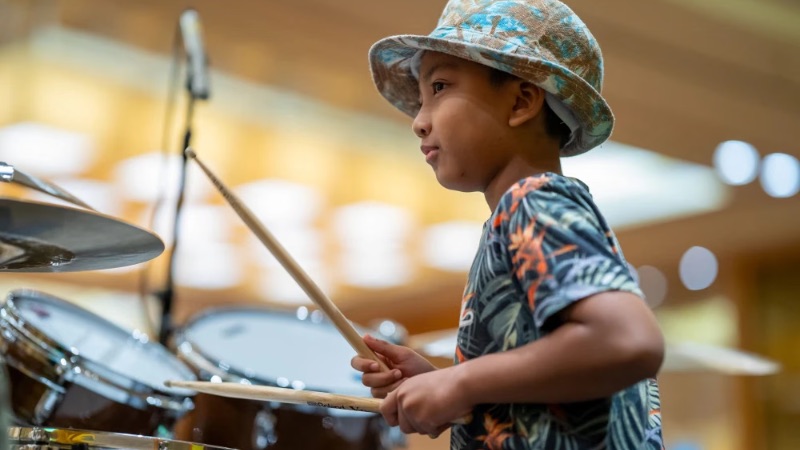
What Can Kids Usually Learn First on the Drums?
Kids can begin with simple, repeated beats before gradually adding more movements and parts of the drum kit. A beginner might first practise a steady rhythm on the hi-hat while counting “1-and-2-and-3-and-4-and”. Once this feels comfortable, they can add the snaredrum on beats 2 and 4, followed by the bass drum with one foot on beats 1 and 3.
Together, these movements form a basic drum beat: the hi-hat keeps the pulse, the snare adds the backbeat, and the bass drum provides the foundation. Learning each part in sequence helps kids become familiar with the individual movements before combining them into a complete rhythm. Early learning is about building the basics step by step, not doing everything at once, so that first lesson is far more “one steady beat” than “full kit chaos.”
Can Beginners Play Simple Drum Beats Early?
Yes: a child may begin with a simple beat using only a few repeated movements before adding more parts of the drum kit. That said, it’s worth keeping expectations in check: not every child will be playing a full song by the end of their first lesson, and that’s completely normal.
In the early weeks, you might hear your child counting out loud while they play, or repeating the same short pattern over and over until it starts to sound even. That repetition is exactly how the basics settle in, and it’s usually the first sign that a beat is starting to feel familiar.
What Is the Hardest Part of Learning Drums for Kids?
The harder part of drumming usually begins when a child has to do several things at once while still keeping a steady beat. This is where the learning curve genuinely steepens, though it’s a manageable, gradual climb rather than a wall.
Why Is Hand-and-Foot Coordination Difficult at First?
Unlike activities where both hands or feet perform similar movements, drumming requires kids to keep different rhythms going at the same time. For example, maintaining a steady hi-hat pattern while adding a snare hit or bass drum beat means each limb must follow its own timing without disrupting the overall rhythm.
Our drum teachers can help kids recognise where their timing tends to slip, practise challenging combinations at a slower pace, and build up speed as the movements become more natural. The aim isn’t to get every beat right immediately, but to help kids become more comfortable coordinating their hands and feet over time.
At first, you might notice your child’s hi-hat hand stopping every time the bass drum comes in. As coordination develops, the hi-hat keeps going while the other limbs join in, which is a clear sign that each limb is learning to do its own job.
Why Can Keeping a Steady Beat Be Difficult at First?
Knowing where to hit the drums is only one part of drumming. A child may know exactly where to hit but still need practice to keep each beat evenly spaced. Excitement or the effort of remembering the next movement can lead a beginner to speed up or slow down without realising it.
With practice, kids can learn to maintain the same rhythm for longer without speeding up or slowing down. Parents may notice this when their child can play a simple beat from beginning to end at a more consistent pace. This ability to maintain a steady tempo is an important part of developing control, separate from simply knowing which drum to hit.
Does Drumming Get Harder as Kids Progress?
As the music becomes more complex, the challenge isn’t simply playing more notes, it’s staying controlled and consistent while doing more at once. Kids may need to coordinate additional movements, follow more complicated rhythms and maintain the beat through changes in a song. The aim is to build on familiar skills while introducing new challenges at a manageable pace.
Parents may see this when their childs tarts playing along to a favourite song, adds a short fill and lands back on the beat, or moves from verse to chorus without losing their place. Each of these shows a child handling more at once while keeping the music steady.
What Progress Can Parents Expect When Their Child Learns Drums?
Progress is step by step, and it can look different for every child. One child may pick up the basic rhythm quickly but need more time with foot coordination. Another may take longer to start but become far more consistent once the pattern feels familiar. Neither path is better or worse: they’re just different learning rhythms (pun very much intended).
Look out for signs like keeping a beat for longer stretches, coordinating hands and feet with less hesitation, remembering familiar patterns, or recovering from mistakes more smoothly. These small changes can reveal more than just musical progress. When kids recognise a mistake and find their way back into the rhythm without stopping completely, they are learning to work through challenges rather than expecting every movement to be perfect on the first attempt. Remembering familiar patterns with fewer reminders can also signal growing independence during practice. These are meaningful markers of progress, not a fixed number of weeks or a comparison to another child’s playing.
Can Drum Lessons Make Learning Easier for Kids?
Learning independently can be challenging when a beginner is still figuring out how to coordinate different movements. A drum teacher can break a difficult movement into smaller parts, help a child practise them separately, and then bring them together gradually, which is a far less frustrating path than figuring out hand-foot coordination alone through trial and error. Structured guidance also means technique gets corrected early, timing feedback comes consistently, and pacing matches where your child actually is, rather than where a generic lesson plan assumes they should be.
This is the kind ofcoordination-building, step-by-step approach Aureus Academy’s drum lessons are designed around.
Not sure whether drums will suit your child? A trial drum lesson can help them experience the instrument while giving you a clearer sense of howthey respond to the learning process.
FAQs
Does my child need a natural sense of rhythm to learn drums? No. Rhythm andtiming can improve with practice, and a child doesn’t need perfect timingbefore starting drum lessons.
How often should kids practise drums? Regular, manageable practice is generallymore useful than occasional long sessions, but the right routine depends onyour child’s age, level and their teacher’s guidance.
Do we need a full drum kit before my child starts lessons? Not necessarily. Beginners can practisebasic rhythm and stick-control skills without owning a full acoustic kit,though regular access to suitable practice equipment becomes more useful aslearning progresses. There are plenty of rental options you can go for to testthe water first, before making a major investment once your child’s interestlevel in music has stabilised.
Are electronic drums suitable for kids learning at home? They can be a practical home-practice option for some families, especially where space or noise is a concern. The right setup depends on your child, available space and your teacher’s guidance.
Is it too late for an older child or teenager to start learning drums? No. Children and teenagers can start drums at different ages: readiness, interest, consistency and the right level of guidance matter more than hitting one exact starting age.
How long does it take a child to get comfortable playing drums There’s no single timeline. Some kids pick up a basic rhythm quickly, while coordination, timing and control develop more gradually with consistent practice.


